


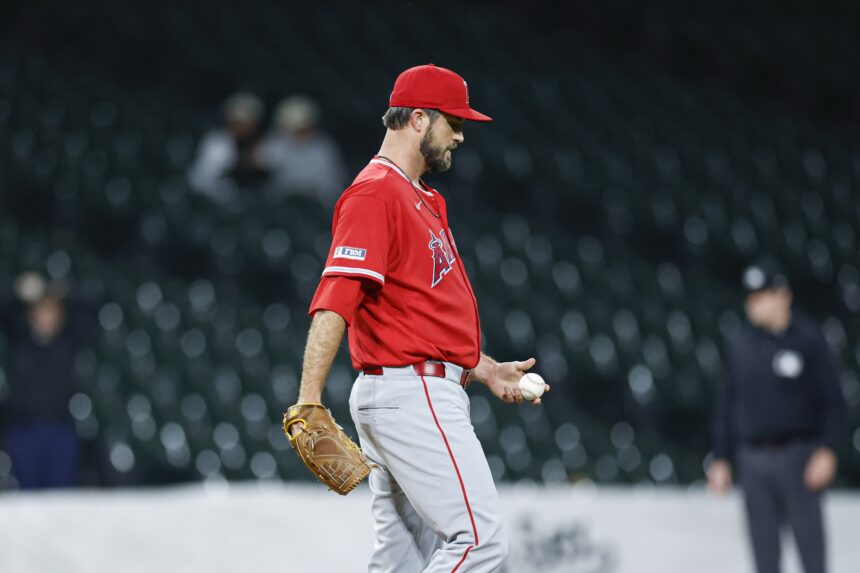
Drew Pomeranz and Jordan Romano arrive in Anaheim with very different recent histories, but they share one key trait that fits the Angels’ 2026 plan: strikeout upside in high-leverage innings. GamblingNerd.com breaks down each player’s stats and what their profiles suggest about how the Angels may deploy them this season.
Both veterans come with clear risk, yet their track records give the Angels a path to a late-inning mix built more on swing-and-miss stuff than safe, low-ceiling arms. For a club that has struggled to lock down games, the front office is banking on upside and experience rather than pure reliability.
Drew Pomeranz: Left-Handed Weapon With Recent Success
Pomeranz reestablished himself as a reliable relief arm in 2025, working entirely out of the bullpen and delivering both results and volume. He finished that season with a 2.17 ERA over 57 appearances, striking out 57 hitters, and showing the type of command that supports consistent late-inning usage.
Those numbers translate to roughly 10 strikeouts per nine innings, in line with his established profile as a reliever who can miss bats when ahead in the count. His walk rate also trended in the right direction, sitting under three walks per nine innings, which reduced free passes and allowed his stuff to play at the top of the zone without as much damage.
Pomeranz has a history of thriving in shorter stints. During his peak relief years in 2020 and 2021, he posted earned run averages in the mid-1.00s with strikeout rates that pushed into elite territory. That version of Pomeranz looked like one of the more dominant left-handed relievers in the game, particularly when his fastball and breaking ball tunneled well.
That past dominance matters because it shows the upside that still exists if his health and mechanics hold. While any early 2026 sample will be small, the Angels will pay close attention to his velocity, swing-and-miss rates, and walk totals more than a single early ERA number. Those indicators will show whether his 2025 form is sustainable in Anaheim.
How Pomeranz Fits the Angels Bullpen
Pomeranz gives the Angels a true late-inning lefty who can do more than just handle one batter. He can work full innings when needed, but his profile is particularly useful in spots where opposing lineups stack dangerous left-handed hitters in the middle of the order.
The Angels can lean on him in the seventh or eighth inning against tough left-handers or mixed pockets that include lefties who struggle with high-spin breaking balls. His strikeout ability allows the staff to use him with runners on base, since he can get whiffs instead of relying on contact and defense.
Because of that, Pomeranz does not need to be locked into a strict inning-based role. The Angels can deploy him based on matchups, leverage, and game state, whether that is a big spot in the sixth or a bridge to whoever handles the ninth on a given night.
Jordan Romano: Former Elite Closer Seeking a Reset
Romano’s profile looks different. From 2021 through 2023, he emerged as one of the most effective closers in baseball, converting a high volume of save opportunities, posting a sub-2.50 ERA, and striking out more than 11 hitters per nine innings. He also earned multiple All-Star nods during that run, underscoring his status as a late-inning anchor at his peak.
His success in that stretch came from a power fastball, a sharp breaking ball, and the ability to execute pitches under pressure. Romano consistently missed bats in the zone, limited hard contact in big spots, and showed the mentality teams look for in a closer.
The recent story, however, includes more risk. In 2025, Romano’s production dropped sharply. His ERA climbed above 8.00 across 49 appearances, and he allowed double-digit home runs in a little over 42 innings. The spike in home runs and runs allowed reflected both command issues and less margin for error when his pitches leaked to the heart of the plate.
Injuries have also played a part. Romano dealt with right elbow inflammation in 2024 and eventually underwent arthroscopic surgery to address an impingement. That background helps explain some of the volatility in his recent numbers. It also frames his 2026 season with the Angels as a bounce-back opportunity if his elbow holds up and his command returns.
Romano’s Role and Risk in Anaheim
For the Angels, Romano represents a classic reclamation closer. If his stuff looks closer to his 2021–2023 form, he can factor directly into ninth-inning decisions and give the team a proven option to finish games.
At the same time, his 2025 performance suggests the club cannot assume instant stability. The Angels will likely monitor his early 2026 walk rate, home run rate, and the quality of his fastball and slider. If he limits free passes and keeps the ball in the park, his strikeout ability still gives him closer-level upside.
If he struggles, Romano can still serve as a high-leverage right-hander in earlier innings, facing tough right-handed hitters in the seventh or eighth. That flexibility allows the Angels to ease him into the most critical spots, then expand his role if the results and underlying metrics improve.
A Bullpen Built on Strikeouts and Upside
By bringing in both Pomeranz and Romano, the Angels have signaled a preference for relievers who can miss bats rather than simply pitch to contact. Pomeranz offers a recent track record of effectiveness with strong strikeout and walk numbers, while Romano brings an elite historical run as a closer paired with a more recent rough season.
In practice, this shapes a bullpen that can mix and match late in games. Pomeranz can handle tough left-handed pockets or bridge innings, and Romano can work in high-leverage right-handed spots with the potential to reclaim full-time closing duties. Other relievers can slide into complementary roles around those two, depending on matchups and health.
The downside is obvious. Both pitchers come with volatility, whether tied to health, age, or recent performance swings. If Pomeranz’s command backs up or Romano’s home run issues persist, the Angels could find themselves again searching for stability in the late innings.
The upside, though, is meaningful. If Pomeranz sustains his 2025 form and Romano moves closer to his early-2020s peak, the Angels could turn a recent weakness into a relative strength. In that scenario, the bullpen gains strikeout punch, versatility, and multiple options to close out wins throughout the 2026 campaign.